
Wildebeest Migration in Serengeti National Park
The wildebeest migration in Serengeti national park is the world’s second greatest animal migration, trailing only Namibia’s Bat Migration, which sees over 10 million bats move from October to November.
Not just in Tanzania, but around the globe, the Serengeti National Park is one of the greatest scientific and natural scenic tourism destinations. The park is known for having the highest population of animals, particularly open layouts and predators. The Serengeti National Park is located in northern Tanzania, along a well-known tourist route. The Serengeti National Park spans approximately 14750 square kilometers of land. It spans from Kenya’s south coast to the Masai Mara national reserve, constituting the world’s largest and oldest ecosystem, the Mara-Serengeti ecosystem. In 1952, the Serengeti National Park was formed.
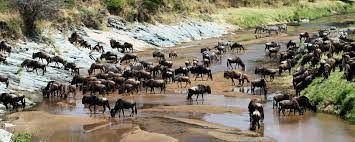
The yearly wildebeest migration is the most recognized feature of Serengeti National Park.
It is because of this that the park was named one of the world’s seven natural wonders.
More than 70 mammalian species and 500 avian species live in the park. During the Serengeti national park migration, millions of wildebeests and tens of thousands of other plains animals migrate from one region to the next. Throughout the year, the Serengeti national park’s migratory circuit is complete. As a result, visitors have been flocking to the park all year. The wildebeest migration has established Serengeti National Park as one of the greatest wildlife viewing destinations in the world, not only in Tanzania but across Africa. During the Mara river crossing period, which runs from July to August, the Serengeti national park migration reaches its pinnacle.
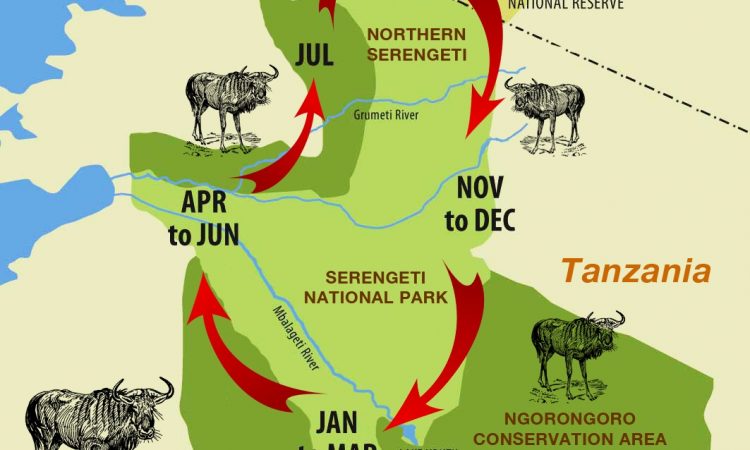
The wildebeest migration in Serengeti National Park varies depending on the weather of the year; some years it begins early, while others it begins later. The animals forecast rain by continuing their motions until they complete the circle. The migration begins in the Southern Serengeti, in the Ndutu Area, near the Ngorongoro Conservation Area. Thousands of wildebeest calves are born every day at this period, which is known as calving season. The grass in the Ndutu region is short and wonderful at this time of year. Every year, from February to March, is the greatest time to see the Serengeti national park migration. Because predators will be targeting newborn defenseless calves that are born, the predator population in this region will likewise rise. Surprisingly, when young calves are born, they take only a few minutes to grow robust and begin playing.
After all the calves are born and strong in March, the wildebeest and other plain animals begin their migration to Seronera in the middle Serengeti. They will be grassing along the Seronera River throughout the wet season. This is the finest time to see the Serengeti’s center region.
It’s amusing how the Serengeti national park migration follows the rains. When the rainy season ends in mid-May, the Serengeti national park migration begins to migrate to the western Serengeti. They’ll focus near the Grumeti river at this point They’ll be grazing along this river as they make their way to the Serengeti’s northern reaches. Every year in June, the Serengeti national park migration crosses the Grumeti river. This is one of the most dangerous little rivers, with more crocodiles and other predators, making it unfit for a life during the crossing time
The Serengeti national park migration continues to the north of the Serengeti national park in June after crossing the Grumeti river. In Serengeti National Park, this is the season when the sun is scorching hot. The Serengeti national park migration reaches its pinnacle at the Mara river, when millions of wildebeest, zebras, and other species cross the river. The survival of the fittest has arrived. Because the wildebeest do not have a leader, the exact day of crossing cannot be anticipated. The animals grazes along the riverbanks for a while before plunging into the water under the watchful eye of the Nile crocodiles. On both sides of the river, land predators are on the lookout. Although there is no leader, the animals travel in a clockwise pattern. The migration starts in the Ngorongoro Conservation Region, in the Ndutu area, and circles clockwise.
The availability of grazing grass determines the migration in a natural way. Because the two animal species consume different parts of plants, thousands of wildebeest and zebras migrate together. This allows them to travel without rivalry for the grass, as one continues to eat its portion while the other is left alone.
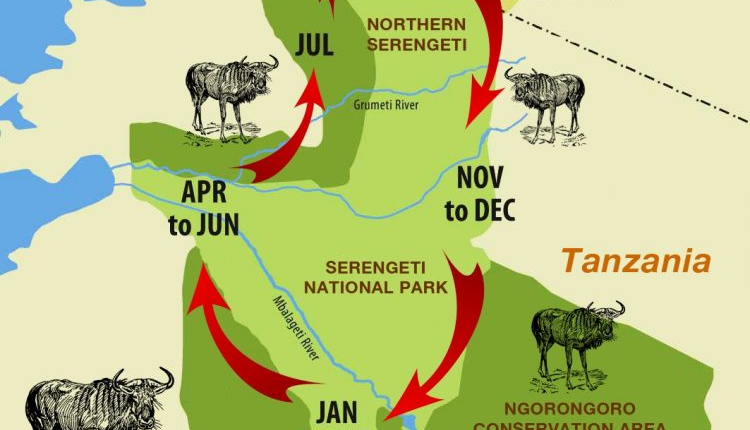
Follow the Calder below for the optimum wildebeest migration in Serengeti national park
The months of December through March
The Serengeti national park migration begins in this month in the Southern Serengeti national park in the Ngorongoro crater Conservation Region in the Ndutu area. This movement is known as the Calving Season Migration, and if you want to see it, come at this period, which peaks in January and February. By March, the wildebeest have moved to the Seronera region in the middle Serengeti national park.
From April through June,
The Serengeti national park migration is generally in the middle Serengeti Area in Seronera from April to mid-May. This is the greatest time to visit and stay in the Seronera region since the central plains are home to millions of wildebeest. As the rains begin to fade around May, the wildebeest resume their migration to the Serengeti’s western reaches. The wildebeest will cross the Grumeti river in June on their way to the north. If you’re interested in watching the migration, you’ll want to go to the western portion of the Serengeti this month.
The months of July and August
This is the peak of the wildebeest migration in Serengeti national park, which takes place in the Serengeti’s northern section. The wildebeest will cross into Kenya via the Mara River, but the exact dates are unknown, but the experience will be unforgettable. To see the migration, you must arrange near lodgings months in advance. As early as four months before the event, the rooms will be fully occupied. The migration of the Serengeti brings more people to the park since everyone wants to see one of the world’s seven natural wonders in person.
The ideal time to visit Serengeti National Park is during this season. One of the greatest safaris in Africa is combining the Masai Mara National Reserve with the Serengeti National Park. It can take up to a week and provide an unforgettable experience as you follow the migration of the Serengeti National Park.


Leave a Reply
Want to join the discussion?Feel free to contribute!